It’s the Little Things – Movies and Kissing

Last night Joe came home from work and said that our friend Lorenz wanted to go to a movie. He was going to see Mission Impossible 4, which is not really Joe’s favorite kind of movie, so instead he came home and said he would stay with the kids if I wanted to go out. Are you kidding me! It was like a miracle. In fact, I’m a little embarrassed at how much I wanted to go out! You would think seeing an American movie in an urban movie theater would be a familiar experience, but once again, it was the little things that made it a cultural experience.

Movies

Surprisingly, the concession stand wasn’t even open when we arrived a few minutes before the start of the movie. My desire for a bubbly beverage was squashed. Oh well. We walked into the theater, and he led me to our assigned row and numbered seats. Yes, there were reserved seats at the movie theater, instead of first-come-first served seating, which seemed to make a lot of sense. Then, Lorenz informed me that there would be an intermission. Really? Sure enough, right as Tom Cruise was about to jump out a window of the tallest building in India, the screen went dark and the lights came up.

Fortunately this meant I could get my drink after all. I ordered a clear soda, and got a mineral water – something I am slowing growing to appreciate. Lorenz ordered a Rivella, an extremely popular Swiss soda that comes in three color varieties. He got Red. Oh, and the drinks don’t come in giant cups with a straw and lots of ice. In fact, you almost never get ice in Switzerland. If you ask for ice in your drink at a restaurant, the waiter usually looks worried, and then you get one or two cubes in a cup. In any case, at the movie theater, they simply handed us 16 oz bottles of our bubbly beverages, and we returned to our seats for the rest of the movie.

The movie was shown in the original English, which was great for me. But, in Switzerland there is not just one set of subtitles, but two – German on top and French on the bottom. Oh, and when the characters were speaking in Russian, then there were three lines, and I had to read the middle one. Once I adjusted to this, it was no problem, and we had a great night out.

Kissing

You’ve probably seen or encountered the European custom of cheek kissing, either on screen or in person. I think of it as being very French, but it occurs in many countries. I never thought much of it, but when you are confronted with it face to face, literally, it can be a little awkward. Think about it. Where do you put your hands? Which side do you kiss first? How many kisses – 2 or 3? If you do any of these things wrong, you can end up in a really embarrassing situation with someone whose face is one inch away from yours!

Fortunately, in Switzerland there is still a lot of hand shaking. And I do mean a lot. There is a custom of shaking hands with everyone at a party or gathering when you arrive, and again before you leave. This still occurs at a lot of meetings and social gatherings, even choir practice. Though in my experience, there is a limit of about 10 people before the greetings just get too cumbersome and stop.

Cheek kissing is reserved for people who are more than passing acquaintances. In a way that makes it even more confusing. Which greeting should I do!? There are just a small handful of people who have initiated this greeting with me. And, after some slightly embarrassing trial and error, I have learned that three kisses starting to the left side (right cheek) is customary here.

Though my favorite cheek kisser is Henry. He just puts his lips to my cheek and says “mmmmaa.” And it always makes me smile, no matter how many mistakes I’ve made that day.

Small Christmas Miracles

James has been having a bit of a difficult Christmas. He’s admitted to being pretty homesick, and I think that the holidays coming on were making him think more of home. More than that, though, James became convinced this year that Santa wasn’t real. And this wasn’t just a fleeting thought. He would argue about it. He would yell at his sister about it. He would get upset when anyone suggested otherwise.

So Sarah and I talked to him. We pulled him aside and said we thought it was fine if he didn’t want to believe in Santa Claus. He told us that he thought we were the ones who brought presents on Christmas. We told him that was true. But we also told him that it was important to his younger brother and older sister that Santa really existed. So we said that, for now, we would not discuss whether Santa existed in front of Emily and Henry, unless they wanted to talk about it too. He was OK with that.

Then we went on our Christmas Vacation in the Alps and a few small things happened. First, while enjoying our presents on Christmas Eve, a small bell rang from the next room, when the kids went in they found a few more presents and evidence that the Christkind had been there.

Santa's note on our tree

That night, at dinner, the Weihnachtsmann visited. The kids were suspicious of this man, but he pulled me aside, and asked me if I knew an Emily and James. I told him I did. He handed me two packages and told me that they contained a very special Swiss treat only for boys and girls who were ready to accept them. The Weihnachtsmann had singled out Emily and James.

Finally, when we arrived home in Münsingen, we found our fireplace open. There were bootprints and ashes around our tree. James detected hoof prints in the backyard. Most importantly, there were presents under our well-cared for and watered Christmas tree. There was also a note on the tree that read:

Dear Emily, James, and Henry,

I hope you had a great Christmas in the mountains. I told my friend Christkind to visit you there. But I couldn’t leave out any of my American children around the world, so I brought a few things to your home in Switzerland.

See you next year back in Milwaukee!

Love,
Santa

P.S. I hope you don’t mind – the reindeer were very thirsty from the long trip, so they took a drink from your pond.

The Kids can't believe that Santa came!

James, Emily, and Henry all jumped around the room yelling that they couldn’t believe it! Santa had come to visit them in Switzerland. James told Sarah and I that he couldn’t believe that he was wrong about Santa. Then he told us he couldn’t believe that we were wrong about Santa, too.

We agree. How amazing it can be to believe again.

Christmas in the Alps

Spending Christmas away from family is a difficult thing. Every present we opened that had been shipped across the ocean was simultaneously exciting and depressing. We Skyped with many of our family members, which is bitter sweet. It was wonderful to see everyone and share holiday greetings, but hanging up (sometimes with tears) brought us back to our quiet hotel room again. But, since we are staying in a lovely hotel in Kandersteg, Switzerland in the heart of the Berner Oberland surrounded by the Alps, there are many beautiful things and new experiences to keep our minds from dwelling on home, and make this a Christmas to remember.

On Christmas Eve, the hotel had a torchlight walk through the woods. So, as the sunlight was fading away behind the mountains, we gathered with an international group of fellow guests, plopped Henry on his sled (his primary mode of transportation for the week), and received our flaming torches. Even Emily and James were given torches, along with a short lecture about fire safety. There was a light snow falling as we paraded toward the woods and away from the lights of the town, until we found ourselves among snow covered evergreen trees, with only torches to light our way. After a short walk, we stopped in a clearing and enjoyed some glühwein for the adults and hot apple cider for the children, before returning to the hotel.

We had a lovely, 4-course Christmas Eve dinner in the hotel dining room, including cream of walnut soup, duck breast, and gingerbread ice cream. After dinner the Weihnachtsmann (German for Santa) came to visit all the children in the lobby and handed them each a small stocking filled with Swiss chocolate. This was something the hotel arranged for its primarily British clientele.

The Christmas tradition in Germany and Switzerland is for the Christkind, or Christ Child, to bring presents on Christmas Eve. Often represented by an angel, the Christkind comes when no children are in the room, and rings a bell to call them back, though the children never actually see him. So, back in our hotel room, the kids were playing with some of the toys they had received earlier that day when a bell rang in their bedroom. They looked at each other quizzically and then jumped up to see what it could be. They opened the door and there was a rush of cold air from an open window, which they looked out to catch a glimpse of a present-bearer, but there was no one there. Then they noticed some gifts left in the room, which they immediately got to open. It was our first visit from the Christkind.

We struggled to get the kids into their pajamas and said a prayer for our families so far away. We fell asleep to the ringing of church bells at the small alpine church next door calling worshipers to midnight mass.

White Christmas

Snow has finally arrived! It started over the weekend, and has been falling on and off for about four days. As I write this, I am looking through our wall of windows at fluffy snowflakes falling into our backyard, covering trees and bushes with a picturesque white lining. It is truly a Winter Wonderland.

Remarkably, although it’s been snowing for several days, the accumulation is only a few inches. But that’s all it takes. Somehow a layer of snow makes our kids, who refused to go outside when it was a few degrees warmer, want to bundle up and build snowmen, throw snowballs, and just stick their tongues out and look skyward. (Or, if that doesn’t yield enough satisfaction, pick up a handful of snow and just eat it.) When they finally come in with rosy cheeks, we snuggle around our fireplace drinking hot cocoa.

The Swiss people love the snow and have been waiting for it longer than usual this year. They have a huge winter tourism season here as people come from all over the world to go skiing and experience a Swiss winter. And now we are starting to see why. I still have presents to wrap and packing to do, so for the moment I am content to enjoy the snow through my windows. I plan to light another fire, put on some Christmas music and sing “Let it Snow, let it snow, let it snow!”

Besides, this is good preparation for our Christmas in the Alps, where they have had snow for several weeks already. One of our favorite travel guides, Rick Steves, spent Christmas in the Alps a number of years ago. He stayed in Gimmelwald with Olle and Maria, just like we did back in October. Gimmelwald is a smaller town and more secluded setting than where we will be, but his video captures many Swiss things we have experienced, like sledding on traditional wooden toboggan sleds, eating fondue, reckless use of fire, and some Christmas traditions including Samichlaus and Schmutzli (not “Smoochli” as Rick Steves mistakenly pronounces it).

So, from snowy Switzerland, “Frohe Weihnachten!”

Christmas is in the Air

My gift packages have been sent, our Christmas picture has been taken, and we’ve watched several Christmas specials on TV. Our decorations are up, minimal though they may be. But, this year we are adding some new experiences to our Christmas season.

First, I have seen my first real holly tree. They are very common here for landscaping. I even snipped a few sprigs for my advent wreath and decorations. Did you know that holly leaves are extremely sharp? The prickers on each point of the leaves are like needles. Ouch! You can see a whole holly tree in our Christmas season photo gallery.

On Sunday, our town of Münsingen had a Weihnachtsmarkt or Christmas market. The streets were filled with with stands selling homemade trinkets, baked goods, and other seasonal items. I finally had my first glass of glühwein. Samichlaus (the Swiss Santa Claus) and his sidekick Schmutzli were walking the streets handing out the traditional gifts of nuts, clementines, and chocolates to any children who do a little song or poem for him. Unaware of this requirement, Emily and James approached him in hopes of free loot, but found themselves singing “Jingle Bells” in front of a crowd of onlookers.

Yesterday, December 6th, was St. Nicholas Day, which is an important part of the Christmas season in Switzerland. As usual, we did it wrong. I grew up with St. Nicholas coming on the night of December 5th and filling our stockings. We don’t have stockings, so the kids left out their shoes (actually they left their rain boots, reasoning that they are bigger and would fit more stuff!). They woke up on the morning of the 6th to find them filled with little treats. But, in Switzerland, St. Nick doesn’t come until the evening of the 6th. Oops. During the day, he visited the schools where both Emily and James received a bag of nuts, chocolates, and clementines. Then, he visits family celebrations in the evening.

I went to choir practice that night, and we sang a beautiful arrangement of “Stille Nacht” as well as other pieces we are preparing for the Christmas service. I was surprised to see tables of – that’s right – clementines, nuts and chocolates, as well as tea, wine, and home made treats. We ended our practice a little early and sat down to share some holiday gemütlichkeit.

The Christmas spirit is definitely in the unseasonably warm air. Now, if only the rain outside would turn to snow…

It’s the Little Things – Calendars and Garbage

Today was just another normal day for us in Switzerland. In many ways, our life here is similar to what it was in America – kids go to school, Joe goes to work, there is housework, playdates, homework, shopping. And yet, there are so many little ways in which it is different. And when all the little differences are added up, it gives a picture of what it means to live in another culture and country. So, this is the first of an occasional series I call “It’s the Little Things” that will highlight some of the ways things are different here.

Advent Calendars – I’ve seen Advent calendars in America. In fact, we have one that has 24 felt characters that go onto a manger scene. But, here, Advent calendars are everywhere. Counting down from December 1st to the 24th is an important part of the Christmas season. The Brumanns, our friends from Basel, sent each of our kids an Advent calendar with paper doors that open to reveal pictures. They said their children used to have them every year and always looked forward to opening the doors. I didn’t think opening little one-inch square doors to see a picture would be that exciting, but my kids love them! They can hardly wait to open the next door. James also made another one at school with his own pictures behind each of the doors. Since today was December 1st, the kids finally got to open the first doors, and for the next 23 days, they will giddily open four doors on our Advent calendars, just like Swiss children have done for generations.

At school, the kids also have a form of an Advent calendar. There are small gifts for every school day between now and Christmas, and every day they pick the name of a student out of a bag. The lucky child gets to select a gift to open and keep.

Garbage – I know, I know… who wants to read about garbage?! But, I actually think the handling of garbage is a window into cultural values.

There are 7 categories of garbage here: plastic recyclables, paper recyclables, other recyclables, yard waste, compostable garbage, bread, and everything else. Regular garbage goes into specific mandatory municipal garbage bags that are available at the store, and are priced not just for the bags themselves, but for the volume of garbage they hold. Since garbage collection is not paid for entirely by taxes here, this is one of the ways they cover the costs while encouraging people to limit their waste.

Limiting waste is important here, and there are many ways people do this, but my favorite involves old bread. We’ve mentioned before that nearly all the bread is fresh bakery bread that only lasts for about 36 hours, which not only means that we have to buy bread just about every day, but it also means there can be a lot of rock hard bread crusts and end pieces left over. Interestingly, the bread does not mold, it just gets hard. Our landlady gave us specific instructions about what to do with all of our bread scraps: “feed them to the ducks.” So, about once a week, we go on an expedition looking for ducks on one of the creeks near our house. And today we hit the jackpot! While Emily was at school in the afternoon, James and Henry and I found about 40 ducks eager to eat our bread crumbs. So eager they were even jumping up on the steps where we were sitting. A couple times, they snatched pieces right out of James’s hands. It was the highlight of our afternoon. (Meanwhile, I gave Emily 4 Swiss Francs, and on her way home from school, she stopped in the local family-run butcher shop/market and bought a loaf of bread to bring home. I love that my 7-year-old can do that!)

There are no garbage disposals here, but throwing biodegradable food waste in the garbage is not ideal. Many people, including us, put food waste into a compost bin. Ours is outside next to our garden. Any outdoor waste that is too big for the compost bin goes in the green plastic garbage container for industrial compost that gets picked up occasionally, though I haven’t figured out exactly when. My goal has always been to fill the green container every time, as there is a lot of pruning and weeding that goes on to maintain the extensive gardens here.

In order to recycle things like glass, metal, batteries, etc. we have to haul it (by bike, of course) to a recycling station about 4 blocks from our house and sort it into the appropriate materials and colors. Plastic bottles go to a different recycling station by the grocery store. Paper must be tied up with string or put in paper bags and put out at the curb every other Monday.

Joe tells me that the the Inselspital where he works burns all of its garbage in a special
incinerator that generates power back to the hospital. No waste there!

The fact that these systems work so well here, especially the recycling and required garbage bags, is a testament to Swiss reliability, morality, and environmental consciousness. When they are told to do something, they do it. And for now, so do we.

The Infamous Onion Market

The Bern Onion Market or Zwiebelmarkt is infamous, at least in this area of Switzerland. Of course, we had never heard of it, but we had been told we had to check it out. I wasn’t exactly sure what could be so great about an onion market that takes place on a Monday from 6am – 6pm. But, I packed up the boys, picked Emily up at school and headed to the train station.

As the kids and I got off the train in Bern, we noticed confetti all over the floor of the platform, and throughout the train station. When we stepped off the escalator into the streets of Bern, they were covered with confetti as far as I could see. I was still taking it in and trying to figure out which way to go when a total stranger came up and threw confetti all over us. Once we were covered, we started to join in the fun, scooping confetti off the street and throwing it at each other, and anyone else who seemed willing. (Though we later learned that using street confetti is frowned upon, and we bought a bag of fresh confetti).

The market itself consists of thousands of stands throughout the streets of Bern’s old town. The majority of them sell — you guessed it — onions. But not just any old onions. Perfectly proportioned yellow and red onions that have been tied together with dried flowers into hanging decorations. They come in any size you could want, from tiny ones made with the smallest bulbs to huge ones hanging over 5 feet tall. Some were made into wreaths. The kids even got little onion pins.

Besides onions, you could also buy necklaces made out of breath mints wrapped in colorful plastic wrap, festival items like confetti and squeaky hammers, seasonal baked goods like magenbrot, and food stands selling onion cakes and glühwein (Swiss mulled wine), among many other things. Emily opted for a blue mint necklace, while James chose a confetti gun, and of course I had to buy a small bunch of onions.

The streets were crammed with people, and we walked around getting bonked with toy hammers and covered in confetti. It is said that this is the one day when Bern, a city that is thought of as reserved and a little uptight, lets off some steam and goes a little crazy. I realized it would be too difficult to try to eat downtown with all the crowds and three young kids, so we made our way back to the train station and headed home for dinner.

When it was time for bed, and I was getting Henry into his pajamas, I took off his diaper and it was filled with confetti! We did our best to shake off as much as we could, but it keeps turning up in pockets, purses, hoods. We can now say that we have experienced the phenomenon that is the Berner Zwiebelmarkt.

Thankful

There is no Thanksgiving in Switzerland. I knew that intellectually, but it is so strange to live somewhere that is completely oblivious to the fact that millions of people in America are traveling, gathering together, eating turkey, and watching football. At least for Halloween, there was some acknowledgement of its existence. But, Thanksgiving is literally unknown here. Nonetheless, we managed to have a very nice day with many Swiss modifications.

After the kids got home from school, they helped bake our Thanksgiving dessert – a Swiss fruit and custard torte. I carved the sugarbeet I had bought at the farm into a traditional Swiss räbeliechtli lantern, which we used as part of the centerpiece. The kids helped finish the centerpiece and set the table. When Joe walked in the door from work, our mini Thanksgiving dinner was ready. We had a chicken instead of a turkey, left-over mashed potatoes, and peas. But, compared to our typical light Swiss dinners, this was something special.

After dinner we went to Emily’s school for her Fall program. The theme was fire, and as we arrived there was a large campfire in the middle of about 100 lanterns the children had made, each lit with a candle. We laughed because at the Laternenacht celebration at our school back in Milwaukee, the lanterns were not allowed to be lit with a candle, only battery operated lights. But, here, the 1st and 2nd graders sang and danced among their lanterns, and then paraded with them to a field behind the school for a show by a fire performance squad. I don’t know how to describe this experience, but it involved fiery jump ropes, swinging buckets of fire, a fire juggler and, for the grand finale, a giant baton with fireworks shooting out of it.

We walked home in time to watch the second half of the packers game live. Coincidentally, the kids don’t have school tomorrow because of a teachers conference, so we let them stay up to watch the Packers beat the Lions. A great way to end our day!

Holiday or no holiday, there are still so many things we are thankful for…

  • people who are patient and kind when speaking German with me.
  • the warmest Fall in Bern in 150 years.
  • mountains and rivers and the fact that I can see them from my town.
  • a loving extended family, whose love is even more important from far away.
  • music, that enriches my life through my choir, my husband’s guitar, and even Swiss toddler songs.
  • three beautiful children who keep me on my toes.
  • a whole aisle of amazing chocolate at the grocery store.
  • and so much more…
Happy Thanksgiving!!
dsc_0005dsc_0009dsc_0020dsc_0028dsc_0031dsc_0038dsc_0040

Keeping it Local

It was another beautiful, sunny fall weekend in Switzerland. People here keep telling us this is not normal, and in fact this is the warmest November on record in Switzerland in over 100 years! Is it global warming? Who knows, but we are enjoying it anyway. Though the Swiss people are complaining that there isn’t any snow yet, as they are itching to start skiing. We stayed home this weekend and did our best to be like the locals.

On Saturday morning, we headed outside to bring our yard and our garden up to snuff. The Swiss are meticulous about their gardens, and ours has been sorely neglected for the past several weeks. So, while the kids played in the street with the neighbors, Joe and I raked leaves, swept walkways, turned over the garden and covered it for the winter. It felt great to dig our hands in the dirt one last time this season.

On Saturday night, we rewarded ourselves by going to the Chäs-Fescht or Cheese Festival that was put on by the local yodeling club (Jodlerklub Alpenrösli Münsingen). Talk about local! It was a lot like a church fish fry in Milwaukee, only instead of fried fish and french fries, they served all-you-can-eat Raclette and Fondue. It took place in a school gymnasium packed with families intermingled at long tables. There was an accordion trio playing traditional music. Unfortunately, there was no yodeling, as all the club members were serving food.

Sunday, we spent the morning basking in the sun by the Aare river. Henry worked up an appetite throwing rocks into the river. As we’ve mentioned before, people are allowed to build a fire anywhere they want in Switzerland. So, Joe built a nice fire on the rocks and we roasted hot dogs for lunch.

To finish off the weekend, I had a performance with the community choir I belong to. In Switzerland, there are a lot of community “clubs.” From sports clubs to cooking clubs, outdoors clubs, music groups, cultural clubs, etc… Once someone joins a club, they often stay committed to it for years and years. I joined the local choir, Kantorei Münsingen, and it has been a great way to meet people and get out of the house one night a week! We performed Antonio Caldara’s Missa Dolorosa at a service in honor of Totensontag or Sunday of the Dead. It is a traditional German holiday, similar to Memorial Day, honoring those who have passed away. The choir performed with a chamber ensemble and four soloists. I don’t have a recording of our performance yet, but you can hear a selection of the piece here.

The Simple Life

When we finally realized we were moving to Switzerland, one of the things I was looking forward to was the fresh food. We’ve talked about what the Swiss eat, but I’m not really talking about that. When you go to a Swiss grocery store, most of the items that you see in the dairy and produce section were probably produced within a few kilometers of where you are buying them. Preservatives are uncommon here. Yogurt and milk usually come from local dairies. Potatoes and apples are also usually local.

Well when it comes to getting it fresh, we got more than we bargained for. Starting in late Summer, we had started taking the kids on bike rides throughout the town to get to know it better, and to enjoy the scenery. Fairly quickly we stumbled across a farm a few blocks down from us. We knew one must be close, by the smell if nothing else, but when we finally found it, we noticed a sign out front that indicated it sold some simple farm items: milk, eggs, potatoes, apples, etc.

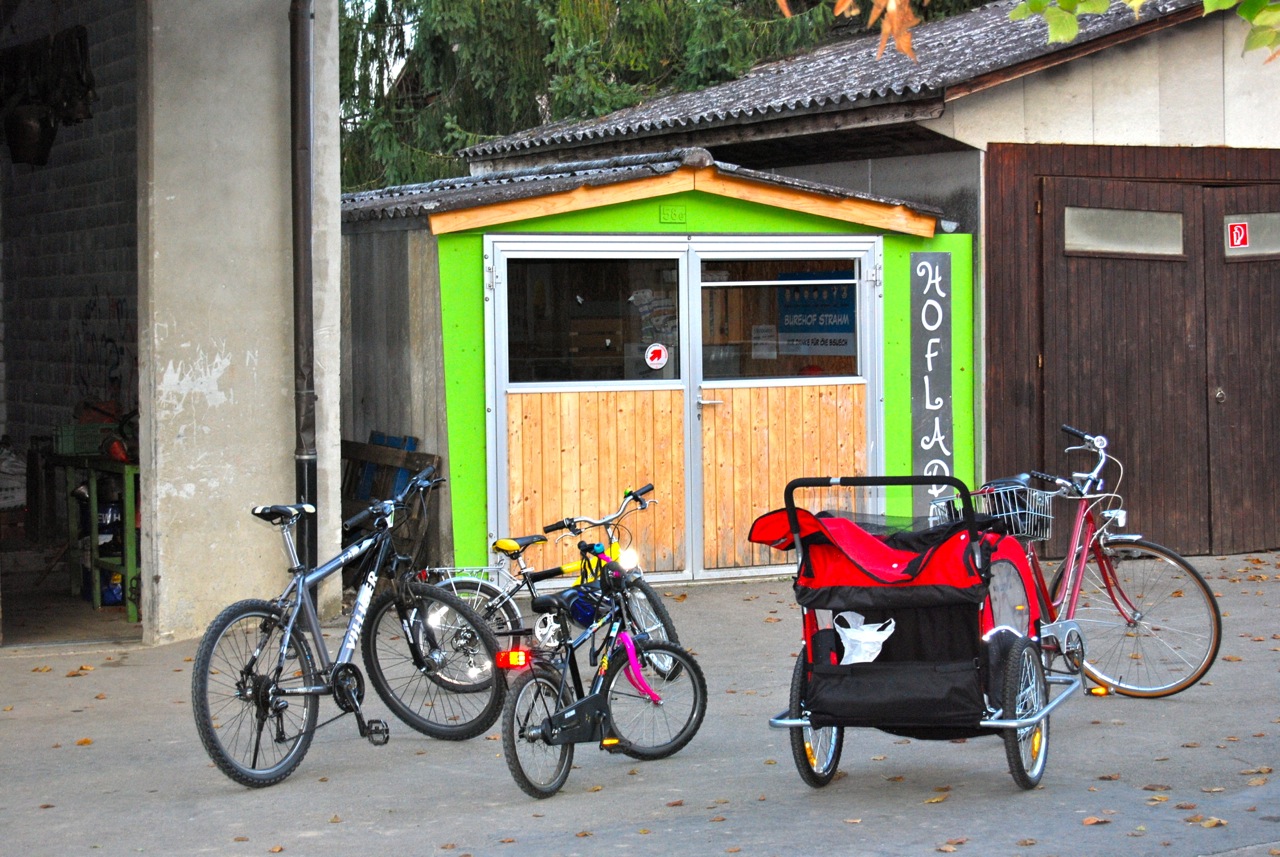
Farm shopWhen we finally looked into it seriously, we found a small stand behind the barn, off the road, that housed their “for-sale” goods. There were baskets of apples, potatoes, various fresh vegetables. There was also a refrigerator filled with eggs. There were also some jarred items like honey, and grape jelly. And in the corner is a scale to weigh your produce, and a small money box that you leave your payment in. There’s no person guarding the stand. No one checks your math. No one even knows if you really even paid.

Buying applesWe went and bought some items one day: potatoes and eggs. The potatoes were labeled by their type (a classification of which I was wholly unaware… they all looked the same to me). Eggs were mixed brown and white, and I believe we met some of the generous chickens while we were there. We wanted to buy milk, and it seemed they had it for sale, but we couldn’t find where it was.

Getting fresh milkAs we were leaving the farm one day, the farmer’s wife was around, so we asked her about milk. She asked us, in German, how many bottles we had. We looked at each other and thought, “bottles?” She smiled, went into the house and brought out a 1.5L bottle, freshly washed. She took us into the milk room which contained a huge stainless steel vat of milk, and explained that we can fill bottles ourselves anytime we want. Just leave payment in the stand for each liter.

Groceries from the farmSo now, about two or three times a week, we head back to the farm, wave to the cows, chat with the farmer, his wife, and mother, get our basics (milk, eggs, apples, potatoes), check on anything new they have that day, pay for our groceries and leave. The milk has never tasted so good. If we want cream for our coffee, we just pour it off the top of the milk in the morning. And better than that, I can check on the cows anytime I want, just to make sure they’re doing fine.

dsc_0756dsc_0850dsc_0852dsc_0854dsc_0856dsc_0858dsc_0859dsc_0860